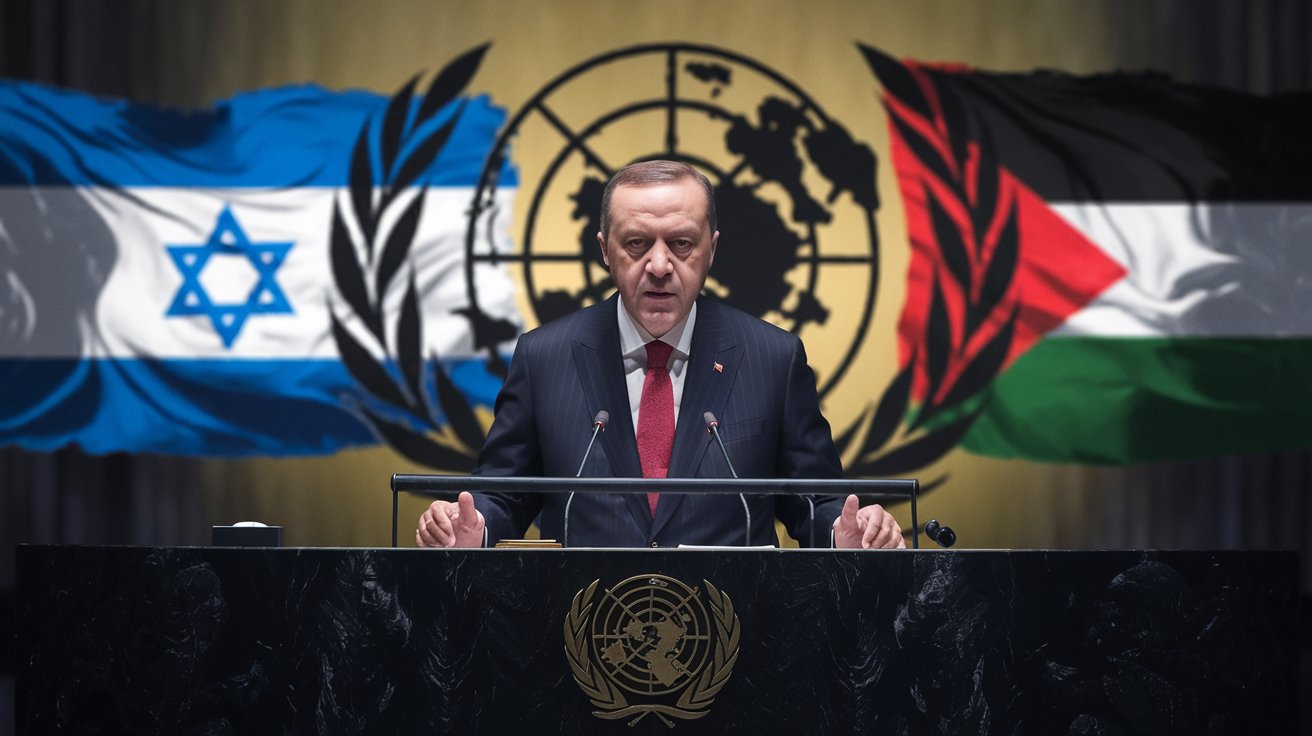
When I first read the headline, I had to do a double take. Turkish President Recep Tayyip Erdogan, known for his outspoken views on international issues, had urged the United Nations to endorse the use of force against Israel. It felt surreal, almost like a moment plucked from a history book, where tensions escalate, and the world holds its breath.
Thank you for reading this post, don't forget to subscribe!
At the recent UN General Assembly, Erdogan made it clear that he believes the time for diplomatic talks with Israel is over. He’s been a vocal critic of Israel’s policies toward the Palestinians for years, but this call for action took it to a whole new level. He’s not just calling out Israel anymore; he’s pushing for the international community, especially the UN, to consider using force. For someone like me, watching from afar, it’s hard not to feel a bit uneasy. I can’t help but wonder: Is this the beginning of something much bigger?
Erdogan’s reasoning for such a drastic stance centers around what he describes as the continuous suffering of the Palestinian people. He argues that decades of negotiations and peace talks have achieved little, and it’s time for the world to take action. His speech painted a bleak picture of the ongoing conflict, citing the loss of Palestinian lives, the destruction of homes, and the restricted access to essential resources like water and healthcare.
But as compelling as Erdogan’s words might be to some, urging the UN to endorse the use of force against a sovereign nation is a dangerous road to walk. It’s not just about Israel and Palestine anymore—this has the potential to drag other nations into a full-blown conflict. Imagine a scenario where the UN takes Erdogan’s advice. How would Israel react? What about the United States, one of Israel’s strongest allies? And where does this leave countries in the Middle East that are already caught in a web of alliances and rivalries?
I get it—people are frustrated. Decades of violence, displacement, and failed peace efforts have led many to feel like there’s no other option but to take drastic action. But calling for the use of force, especially on a global stage like the UN, is like throwing gasoline on a fire that’s already burning. What Erdogan is asking for isn’t just about helping Palestinians; it could set off a chain reaction that leads to more chaos and destruction.
Interestingly, Erdogan’s demand comes at a time when Turkey itself is navigating tricky diplomatic waters. His government has had its fair share of tension with Israel, but in recent years, there have been attempts to normalize relations. So why now? Why push for such an extreme measure when there seemed to be an effort to rebuild bridges?
Some analysts believe Erdogan is making a calculated political move. By taking such a strong stance, he solidifies his image as a champion of the Palestinian cause in the eyes of the Arab world and Turkey’s own citizens. It’s a way to gain influence and rally support domestically while appearing to stand up against a powerful adversary like Israel.
But regardless of the political motivations, the fact remains: a push for the UN to endorse the use of force is a dangerous and unpredictable path. The United Nations was founded on the principles of maintaining peace and security. If Erdogan’s call is seriously considered, it could fundamentally challenge those principles and lead to an escalation that no one really wants.
As the world watches this unfold, one thing is clear: this isn’t just another diplomatic spat between two nations. It’s a moment that could shift the balance in the Middle East and beyond. And for the rest of us, all we can do is hope that cooler heads will prevail.

