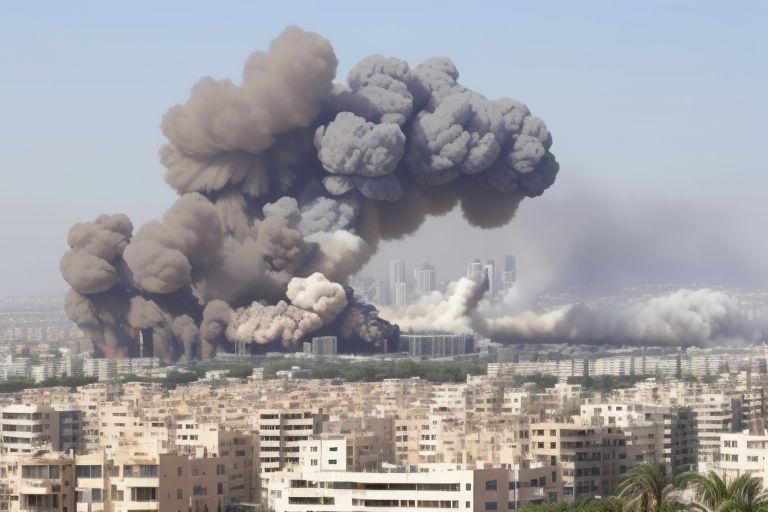
When I first heard the news that Hezbollah had struck Haifa, it felt like the entire world shifted. This wasn’t just another skirmish in a far-off land—this hit close, to the heart of a country that has seen too much violence over the years. The strike from Lebanon’s Hezbollah on Haifa has sent shockwaves far beyond the city itself, leading to a rapid response from Israel that’s left many wondering what will happen next.
Thank you for reading this post, don't forget to subscribe!
It’s hard to imagine the sheer panic of waking up to a missile hitting your city. Haifa, a bustling Israeli port, suddenly became a target in the escalating conflict. Hezbollah, a powerful militant group based in Lebanon, fired rockets in what many see as retaliation for Israel’s bombardment of Gaza. And just like that, the war between Israel and Hamas pulled Hezbollah into the chaos, stretching the conflict across borders.
What Led to This Strike?
To understand why this is happening, you have to look at the bigger picture. Tensions have been simmering between Israel and Hezbollah for years. Hezbollah is backed by Iran and has been watching the war between Israel and Gaza closely, waiting for the moment to make its move. The recent violence in Gaza, where Israeli airstrikes have pounded the strip in response to Hamas attacks, appears to be that spark. Hezbollah’s strike on Haifa signals that the conflict is no longer confined to just Israel and Gaza—it’s spreading.
Israel didn’t waste any time in responding. Almost immediately after the strike, Israeli forces launched a wave of retaliatory attacks on Hezbollah positions in southern Lebanon. Meanwhile, Gaza continues to face heavy bombardment, with many civilians trapped in the crossfire. This conflict has grown into something bigger than just a regional issue—it’s now a global concern.
The Human Toll
While it’s easy to talk about these events in terms of strategy and politics, we can’t forget the people caught in the middle. In Haifa, families scrambled for safety as air raid sirens blared across the city. Children huddled in bomb shelters, unsure of what would come next. Over in Gaza, families are dealing with a nightmare of their own, as Israeli airstrikes pound buildings and homes. Every day, more innocent lives are being affected, and it’s hard not to wonder how much longer this can go on.
What’s most terrifying is how unpredictable everything feels right now. One moment you’re reading the news, and the next, you see reports of a new missile strike or a fresh round of air raids. Both sides are locked in a dangerous game of tit-for-tat, and it’s the civilians who are paying the price.
What Happens Next?
The situation is fragile. Hezbollah’s strike on Haifa marks a significant escalation, and both sides seem unwilling to back down. With so much at stake, many are asking: could this lead to a larger war? For Israel, the goal seems clear—they want to weaken Hamas in Gaza and prevent Hezbollah from gaining ground. For Hezbollah, this could be a chance to flex its muscles and show it’s a serious player in the region.
But no one knows how this will end. The international community is watching closely, with many urging for a ceasefire. Yet, as more rockets fly and more bombs drop, it feels like peace is a distant dream.
In the meantime, we can only hope that cooler heads prevail and that the violence stops before more lives are lost. But right now, it feels like the war is just getting started, and the world is holding its breath to see what comes next.

